
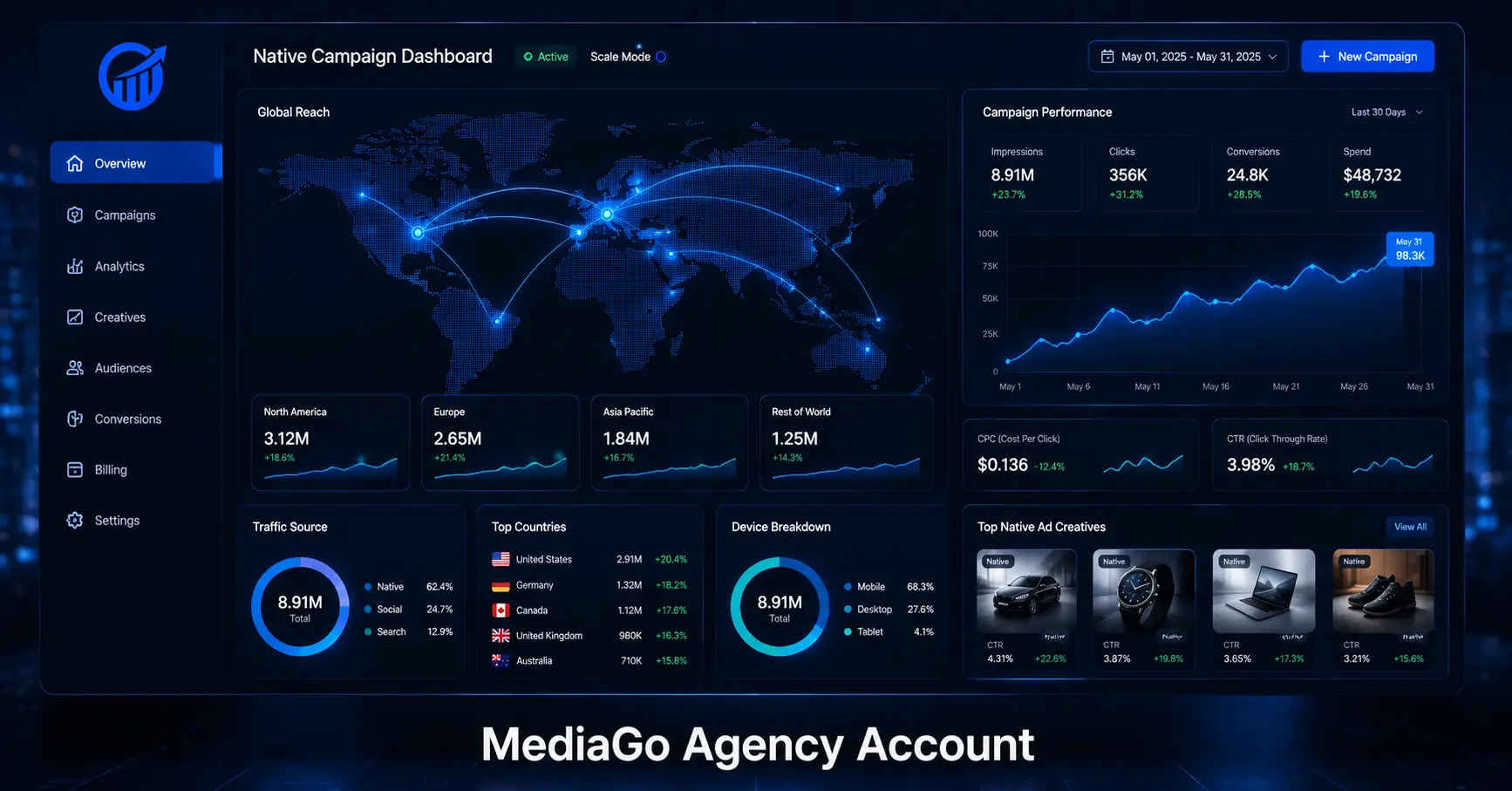
If you’ve been running native ads for any real length of time, you’ve probably hit the same wall every serious media buyer eventually runs into. You find a campaign that converts, you start pushing budget, and then your account gets flagged, your spend limit won’t budge, or your ads get stuck in an approval queue that seems to have no end.
It’s frustrating. And it’s expensive.
This is exactly why more affiliates, agencies, and performance marketers are turning to a MediaGo agency account as their go-to solution for scaling native advertising in 2026. MediaGo Baidu’s global native advertising platform has quietly become one of the most powerful tools in the media buyer’s arsenal, offering access to premium publisher inventory across North America and Europe that most advertisers don’t even know exists.
But here’s the thing: getting real results on MediaGo isn’t just about having an account. It’s about having the right kind of account, one with elevated trust, higher spending capacity, and the infrastructure to support aggressive scaling without the constant threat of disruption.
In this guide, we’ll walk through everything you need to know about renting a MediaGo agency account, how it compares to standard self-serve access, and why it’s become the preferred approach for advertisers who are serious about scaling native ads globally.
Let’s break it down.
Table of Contents
- What Is a MediaGo Agency Account?
- How MediaGo Native Advertising Works
- Why Affiliates Use MediaGo for Native Ads
- Benefits of Renting a MediaGo Agency Account
- MediaGo vs Other Native Ad Networks
- How Agency Accounts Help Scale Faster
- Global Native Advertising Opportunities in 2026
- High-Spend Native Advertising Advantages
- Common Problems With Standard Ad Accounts
- Why Advertisers Prefer Agency Accounts
- How Capital Media Hub Helps Advertisers Scale
- Best Practices for Running Native Campaigns
- Compliance & Account Safety Tips
- Who Should Rent a MediaGo Agency Account?
- FAQs
- Final Thoughts
What Is a MediaGo Agency Account?
A MediaGo agency account is a managed advertising account issued under a verified agency’s partnership with MediaGo Baidu’s programmatic native advertising platform. Unlike standard self-serve accounts that any individual advertiser can create, agency accounts sit under an official partner umbrella, giving them access to elevated trust levels, higher spending thresholds, and premium inventory that isn’t available through regular sign-ups.
Think of the difference this way: a standard account is like walking into a dealership off the street. You’ll get service, but you’ll wait in line and deal with whatever the floor rep offers. An agency account is like having a relationship with the general manager; you get priority, flexibility, and access to inventory that isn’t on the public lot.
For advertisers focused on native ads scaling, this distinction matters enormously. Agency accounts come pre-verified, which means faster campaign approvals, fewer random rejections, and a significantly lower chance of account disruption when you start pushing real budget.
When you rent a MediaGo agency account through a trusted partner, you inherit all of that trust and infrastructure without having to build it from scratch.
How MediaGo Native Advertising Works
MediaGo is a native advertising platform that distributes ads across a massive network of premium publishers, apps, and content sites primarily targeting audiences across 29 countries in North America and Europe. It’s part of Baidu’s advertising ecosystem, which gives it access to proprietary AI-driven targeting technology and a unique audience pool that doesn’t overlap heavily with what you’d reach through Meta or Google.
Here’s how campaigns flow on MediaGo:
- Campaign creation:- You set up campaigns with your targeting parameters (geo, device, OS, audience interests), upload your native ad creatives, and define your bid strategy.
- AI-driven optimization:- MediaGo’s algorithm matches your ads to relevant publisher placements based on user behavior, content context, and engagement signals.
- Native placement delivery:- Your ads appear as in-feed content, recommendation widgets, or contextual placements on premium sites, blending naturally with editorial content.
- Performance tracking:- You monitor clicks, conversions, CTR, and CPC in real time and adjust campaigns accordingly.
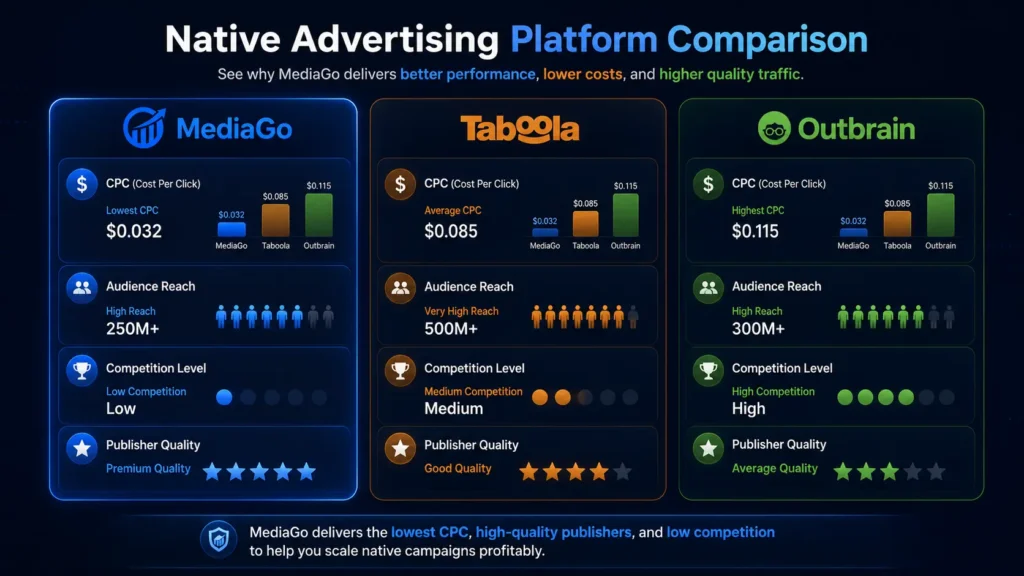
The key differentiator? MediaGo’s CPCs tend to run significantly lower than Taboola or Outbrain in many verticals, and the audience quality, especially in Western markets, is surprisingly strong. Advertisers who’ve been paying $0.80–$1.50 per click on other native platforms often find themselves spending $0.20–$0.60 on MediaGo for comparable traffic quality.
That cost efficiency, combined with the platform’s growing inventory in untapped markets, is what’s driving the surge in interest from media buyers looking for global native ad scaling opportunities.
Why Affiliates Use MediaGo for Native Ads
Affiliate marketers have a unique relationship with native advertising. Unlike brand advertisers who can afford to play the long game with awareness campaigns, affiliates need traffic that converts, and they need it at a cost that leaves margin on the table.
MediaGo native ads check both boxes, which is why the platform has gained serious traction among affiliate marketers in 2026:
- Lower CPCs:- MediaGo’s auction dynamics are less saturated than Taboola or Outbrain, which means lower cost per click and better margins on affiliate offers.
- High-intent Western audiences:- Access to readers on premium publisher sites in the US, UK, Canada, and Europe means the traffic quality tends to convert well on health, finance, insurance, and e-commerce offers.
- Native format credibility:- Ads appear as editorial recommendations, which builds trust and generates higher click-through rates compared to display banners.
- Less competition:- Most affiliates haven’t discovered MediaGo yet, which means less bidding pressure and more room to find untapped angles and audiences.
- Flexible targeting:- Device, OS, geo, and interest-based targeting lets affiliates dial in on specific segments without wasting budget on broad reach.
For affiliates running native traffic, MediaGo represents what Facebook was five years ago: a platform with incredible reach and efficiency that most competitors haven’t figured out yet. The window won’t stay open forever, but right now, the opportunity is significant.
Benefits of Renting a MediaGo Agency Account
So why rent an agency account instead of just signing up for a standard MediaGo account yourself? The benefits go far beyond convenience:
Higher Spending Limits
Standard accounts often come with conservative daily spend caps that take weeks or months to increase. Agency accounts start with elevated limits, letting you push real budget from day one.
Account Stability
Agency accounts are issued under a verified partner’s business entity, which gives them a higher trust baseline. That translates to fewer random flags, fewer surprise suspensions, and more consistent campaign delivery.
Faster Ad Approvals
Campaigns submitted through agency accounts typically clear the review process faster. When you’re testing 10–15 creatives a day, shaving hours off approval time adds up quickly.
Premium Placement Access
Certain publisher placements and inventory tiers are only available to agency-level accounts. This means your ads can appear on higher-quality sites with better-engaged audiences.
Billing Flexibility
Agency accounts often come with more flexible payment structures, including top-up billing with competitive fees (typically 3%–10%), which simplifies cash flow management compared to dealing with credit card authorizations and international payment headaches.
Dedicated Support
When issues arise and in media buying, agency accounts always get prioritized support. That means faster resolution times and less revenue lost to downtime. Looking for a stable, high-trust MediaGo advertising account? Capital Media Hub provides verified agency accounts with premium placements, no daily spend limits, and dedicated support ready to launch within 24 hours.
MediaGo vs Other Native Ad Networks
How does MediaGo stack up against the other major native advertising platforms? Here’s a practical comparison based on what media buyers are actually experiencing in 2026:
| Feature | MediaGo | Taboola | Outbrain |
| Average CPC | $0.20–$0.60 | $0.50–$1.50 | $0.40–$1.20 |
| Audience reach | 29 countries (NA + Europe focus) | 190+ countries | 150+ countries |
| Publisher quality | Premium, curated inventory | Mixed (premium + long-tail) | Premium-focused |
| Competition level | Low–Medium | High | High |
| AI targeting | Baidu’s proprietary AI | Machine learning-based | SmartFeed algorithm |
| Best for | Affiliates, eCommerce, arbitrage | Brand + performance | Brand + content |
| Agency account availability | Yes, through verified partners | Yes | Yes |
| Approval speed | Fast (agency accounts) | Moderate | Moderate |
The standout insight? MediaGo offers a unique combination of lower costs, high-quality Western audience access, and significantly less competition than the established native platforms. For advertisers running Taboola ad accounts alongside MediaGo, the platforms actually complement each other well, Taboola for scale and MediaGo for efficiency.
How Agency Accounts Help Scale Faster
Scaling native campaigns is a fundamentally different challenge from just running them profitably at a small budget. Here’s how a MediaGo agency account removes the friction from that scaling process:
No spending limit anxiety. Standard accounts force you to prove yourself slowly. Agency accounts let you go from $100/day to $2,000/day without triggering automated reviews or spending freezes.
Parallel campaign testing. Want to test 8 different creatives across 4 geos simultaneously? An agency account supports that kind of volume without hitting caps that would throttle a standard account after the second or third campaign.
Consistent delivery during scale-up. When you increase budget on a standard account, there’s often a lag while the platform’s trust systems catch up. Agency accounts absorb budget increases smoothly because the trust is already established at the partner level.
Better algorithmic treatment. Accounts that spend consistently and at higher volumes tend to get better algorithmic placement. MediaGo’s system favors reliable, high-volume advertisers, and agency accounts signal exactly that.
For media buyers managing campaigns across multiple platforms, combining MediaGo with Facebook agency ad accounts or Google Ads agency accounts, the ability to scale quickly and reliably on each platform is what separates profitable operations from ones that plateau.
Global Native Advertising Opportunities in 2026
The native advertising landscape is evolving rapidly, and 2026 is shaping up to be a pivotal year. Here are the trends creating the biggest opportunities:
- Western market expansion:- MediaGo’s publisher network across North America and Europe continues to grow, opening access to audiences that were previously only reachable through premium display buys.
- Privacy-first targeting:- As cookie deprecation progresses, native platforms with strong contextual and AI-driven targeting (like MediaGo) are gaining an advantage over platforms that relied heavily on third-party data.
- eCommerce adoption:- More e-commerce brands are discovering that native advertising for eCommerce drives higher-quality traffic than social media retargeting, with better customer lifetime values.
- Arbitrage opportunities:- Content arbitrage marketers are finding MediaGo’s low CPCs create profitable margins that have narrowed significantly on Taboola and Outbrain.
- Multi-platform strategies:- Smart advertisers are building diversified native portfolios, running MediaGo alongside Taboola, and complementing both with Bing Ads agency accounts for search-intent traffic.
The global native ad market is projected to exceed $150 billion in 2026, and platforms like MediaGo that offer premium inventory with less competition are positioned to capture a disproportionate share of that growth.
High-Spend Native Advertising Advantages
When your MediaGo ad spend crosses $5,000, $20,000, or $50,000+ per month, the dynamics shift in your favor:
Better CPCs at Volume
MediaGo’s bidding algorithm rewards consistent, high-volume spenders. Advertisers spending $500+/day typically see 15–25% lower CPCs compared to accounts spending under $100/day.
Priority Inventory Access
Higher-spend accounts get access to premium publisher placements that lower-spend accounts simply can’t compete for. This translates to better audience quality and higher conversion rates.
Dedicated Account Management
At enterprise native advertising levels, you get access to MediaGo’s own account management resources, strategic recommendations, creative feedback, and optimization support that isn’t available to standard accounts.
Cash Flow Efficiency
With agency accounts, you’re typically working with top-up billing rather than daily credit card charges. This means cleaner financial management, fewer international transaction fees, and better visibility into your actual advertising costs.
Common Problems With Standard Ad Accounts
If you’ve tried running MediaGo campaigns on a standard self-serve account, you’ve probably encountered some of these headaches:
- Low spending limits:- Caps that prevent you from scaling even when your campaigns are clearly profitable
- Slow approval times:- Creatives stuck in review queues for 24–48 hours while your competition runs freely
- Account instability:- Random flags, temporary suspensions, or full disablements with no clear explanation
- Payment complications:- International card declines, currency conversion issues, or rejected payment methods
- Limited support:- Generic help center articles instead of direct access to someone who can actually resolve your issue
- Restricted inventory:- Being locked out of premium publisher placements that are reserved for agency-tier accounts
These aren’t edge cases. They’re the standard experience for most advertisers trying to run native ads at scale on self-serve accounts. And every one of them directly costs you money either in lost revenue, wasted time, or missed opportunities.
An agency ad account eliminates these friction points by operating under a verified partner infrastructure that MediaGo’s systems treat with higher trust from day one.
Why Advertisers Prefer Agency Accounts
The shift from standard to agency accounts isn’t a trend, it’s a logical evolution for any advertiser who’s serious about performance. Here’s why the preference is so strong:
- Risk reduction:- Agency accounts carry lower ban rates because they’re backed by verified business entities with established track records.
- Speed to market:- Skip the weeks-long process of building trust on a new account. Agency accounts come pre-verified and ready to scale.
- Financial flexibility:- Top-up billing with transparent fees (3%–10%) beats dealing with credit card limits, international charges, and payment failures.
- Strategic advantage:- Access to premium placements and better algorithmic treatment gives agency-level advertisers a measurable edge over competitors running standard accounts.
- Continuity protection:- If an account encounters any issue, a good agency partner can transfer your unspent balance to a new account immediately, no funds lost, no campaign downtime.
For advertisers who’ve experienced the pain of losing a profitable campaign because their standard account got suspended, losing pixel data, audience insights, and optimization history in the process, the stability of an agency account isn’t just a nice-to-have. It’s insurance.
How Capital Media Hub Helps Advertisers Scale
Capital Media Hub isn’t just another account reseller. It’s a full-service advertising account solutions provider built for advertisers who are serious about scaling.
Here’s what makes them different:
- Verified MediaGo agency partnership:- Accounts issued under Capital Media Hub’s official partner status with MediaGo, carrying higher trust levels and premium access
- Whitelisted accounts:- Smoother campaign approvals, better delivery rates, and access to placements unavailable to standard advertisers
- Balance transfer protection:- If your account encounters any issue, your unspent budget moves immediately to a new account. No funds lost.
- Complete campaign setup:- Pixel integration, audience configuration, and campaign structure ready to launch from day one
- Compliance pre-screening:- Your creatives, landing pages, and targeting parameters are reviewed for MediaGo policy compliance before campaigns go live
- Multi-platform coverage:- Beyond MediaGo, access TikTok agency ad accounts, Facebook agency ad accounts, Google agency accounts, Snapchat agency accounts, and Bing Ads accounts
- Competitive pricing:- Fees starting from just 3%–10%, with plans beginning at $149.99/month for budgets under $5,000
- 24/7 dedicated support:- Real specialists who work directly with MediaGo’s platform representatives to resolve issues quickly
Ready to scale your native ad campaigns? Contact Capital Media Hub and get set up with a verified MediaGo agency account, and go live within 24 hours.
Best Practices for Running Native Campaigns
Having a MediaGo agency account gives you the infrastructure. But profitable campaigns still require smart execution. Here are the practices that separate successful native advertisers from everyone else:
1. Test Creatives Aggressively
Native advertising lives and dies by creative quality. Test at least 5–10 headline and image variations per campaign before scaling. The difference between a 0.3% CTR and a 0.8% CTR is the difference between losing money and printing it.
2. Match Landing Page to Ad Tone
Native ads work because they feel like content, not advertisements. Your landing page needs to maintain that editorial feel, especially above the fold. Hard-sell pages with popups and countdown timers will tank your conversion rate on native traffic.
3. Start with Proven GEOs
For MediaGo specifically, the US, UK, Canada, and Germany tend to deliver the best traffic quality and conversion rates. Establish profitability in these markets before expanding to secondary geos.
4. Use Dayparting Strategically
Not all hours convert equally. Analyze your conversion data by hour and day of week, then allocate budget toward your peak performance windows. On MediaGo, weekday mornings and evenings tend to outperform overnight hours in most verticals.
5. Monitor Frequency Caps
Native ads lose effectiveness when users see them too many times. Set frequency caps at 2–3 impressions per user per day to maintain engagement quality without burning out your audience.
6. Diversify Across Platforms
Don’t put all your budget into one channel. Pair your MediaGo campaigns with Taboola ad accounts for broader reach, and consider TikTok agency ad accounts for video-first audiences.
Compliance & Account Safety Tips
Running a high-trust agency account comes with responsibility. Here’s how to keep your MediaGo advertising account safe and compliant:
- Follow MediaGo’s content policies:- Review them before launching any campaign. Pay close attention to restrictions around health claims, financial promotions, and adult content.
- Use clean, honest creatives:- No misleading thumbnails, no fake news headlines, no bait-and-switch content. Platforms are cracking down harder than ever on deceptive native ads in 2026.
- Keep landing pages transparent:- Your landing page should deliver on whatever your ad promised. Disclosures, privacy policies, and clear CTAs should all be visible.
- Avoid cloaking:- Showing different content to platform reviewers versus real users is the fastest way to get permanently banned. It’s not worth the risk.
- Communicate with your agency partner:- If you’re operating through Capital Media Hub, keep them informed about your campaign strategy, especially when entering new verticals or testing aggressive angles.
- Track everything:- Proper pixel implementation and conversion tracking aren’t just optimization tools; they’re compliance tools. Clean tracking data proves the legitimacy of your campaigns.
Who Should Rent a MediaGo Agency Account?
Not every advertiser needs an agency account. But if you fall into any of these categories, it’s worth serious consideration:
- Affiliate marketers looking for lower CPCs and untapped native traffic sources
- Media buyers managing native campaigns across multiple geos and verticals
- E-commerce brands looking to diversify beyond Meta and Google with native advertising for eCommerce
- Performance marketing agencies handling client budgets that require stable, scalable infrastructure
- Arbitrage marketers seeking profitable spread between traffic cost and content monetization
- Advertisers who’ve been burned by account bans, spending limits, or payment failures on standard accounts
- Anyone scaling past $3,000/month on native advertising who needs higher limits and better support
If you recognize yourself in that list, running native ads on a standard self-serve account is actively limiting your growth. The infrastructure upgrade to an agency account isn’t just convenient, it’s a competitive advantage.
Frequently Asked Questions
1. What is a MediaGo agency account?
A MediaGo agency account is a verified advertising account issued under an official MediaGo agency partner’s business entity. It provides higher spending limits, faster ad approvals, premium publisher placements, and greater account stability compared to standard self-serve accounts. Advertisers access these accounts by partnering with a verified agency like Capital Media Hub.
2. Is renting a MediaGo agency account safe?
Yes, when you work with a reputable agency partner. Renting a native ad account through a verified provider like Capital Media Hub means your account operates under an official MediaGo partnership with elevated trust levels. The account is fully compliant with MediaGo’s terms, and your unspent balance is protected through balance transfer guarantees if any issue arises.
3. How do affiliates use MediaGo native ads?
Affiliates use MediaGo to drive cost-effective native traffic to affiliate offers, primarily in verticals like health, finance, insurance, and e-commerce. The platform’s lower CPCs compared to Taboola and Outbrain, combined with access to premium Western audiences, makes it particularly attractive for affiliates who need profitable margins on performance-based campaigns.
4. What are the benefits of agency accounts?
The core benefits include higher spending limits, faster ad approvals, premium placement access, lower account ban risk, billing flexibility with top-up payments, dedicated support, and balance transfer protection. Agency accounts operate under a verified partner’s trust level, which gives them advantages that standard self-serve accounts simply can’t match.
5. Can MediaGo agency accounts help scale campaigns faster?
Absolutely. Standard accounts throttle growth with conservative spending caps and slow trust-building processes. Agency accounts bypass these limitations because the trust is pre-established at the partner level. You can launch campaigns at significant budget levels from day one and increase spending without triggering the automated reviews that plague standard accounts.
2. How much budget is recommended for MediaGo ads?
For meaningful testing, start with at least $50–$100/day per campaign to gather enough data for optimization decisions. For serious scaling, most successful MediaGo advertisers operate at $500–$5,000+/day. Capital Media Hub’s plans start at $149.99/month for budgets under $5,000, with competitive top-up fees of 3%–10%.
3. Is MediaGo good for affiliate marketing?
Yes, MediaGo is quickly becoming one of the best-kept secrets in affiliate marketing. Its lower CPCs, high-quality Western audiences, native format credibility, and relatively low competition create an ideal environment for affiliates. The platform is particularly strong for content-based funnels, advertorial-style landing pages, and offers in health, finance, and e-commerce verticals.
4. Why choose Capital Media Hub for MediaGo accounts?
Capital Media Hub is a verified MediaGo agency partner that provides whitelisted accounts with premium access, balance transfer protection, compliance pre-screening, complete campaign setup assistance, and 24/7 dedicated support. Their high-trust advertising accounts span multiple platforms, including Meta, TikTok, Google, Snapchat, Taboola, and Bing, making them a one-stop solution for advertisers who want stable, scalable infrastructure across their entire media buying operation.
Final Thoughts
The native advertising landscape is shifting. Established platforms like Taboola and Outbrain are getting more expensive and more competitive every quarter. Meanwhile, MediaGo is sitting in a sweet spot, premium Western audiences, lower CPCs, growing inventory, and less competition.
But accessing that opportunity effectively requires more than just a standard account. The spending limits, approval delays, stability issues, and support gaps that come with self-serve access will hold you back the moment you try to scale past hobby-level budgets.
That’s exactly what a MediaGo agency account solves. It gives you the trust, the limits, the placements, and the support infrastructure to compete at a professional level, without spending months building an account history from zero.
If you’re an affiliate marketer, media buyer, or agency that’s serious about scaling native ads globally in 2026, the question isn’t whether you need an agency account. It’s how much longer you can afford to run without one.
Capital Media Hub makes the transition simple. Verified MediaGo agency accounts, whitelisted for premium access, with balance transfer protection and 24/7 support, ready to launch within 24 hours.
Stop leaving money on the table. Start scaling with the right infrastructure.
👉 Get started with Capital Media Hub, Talk to a specialist today.