

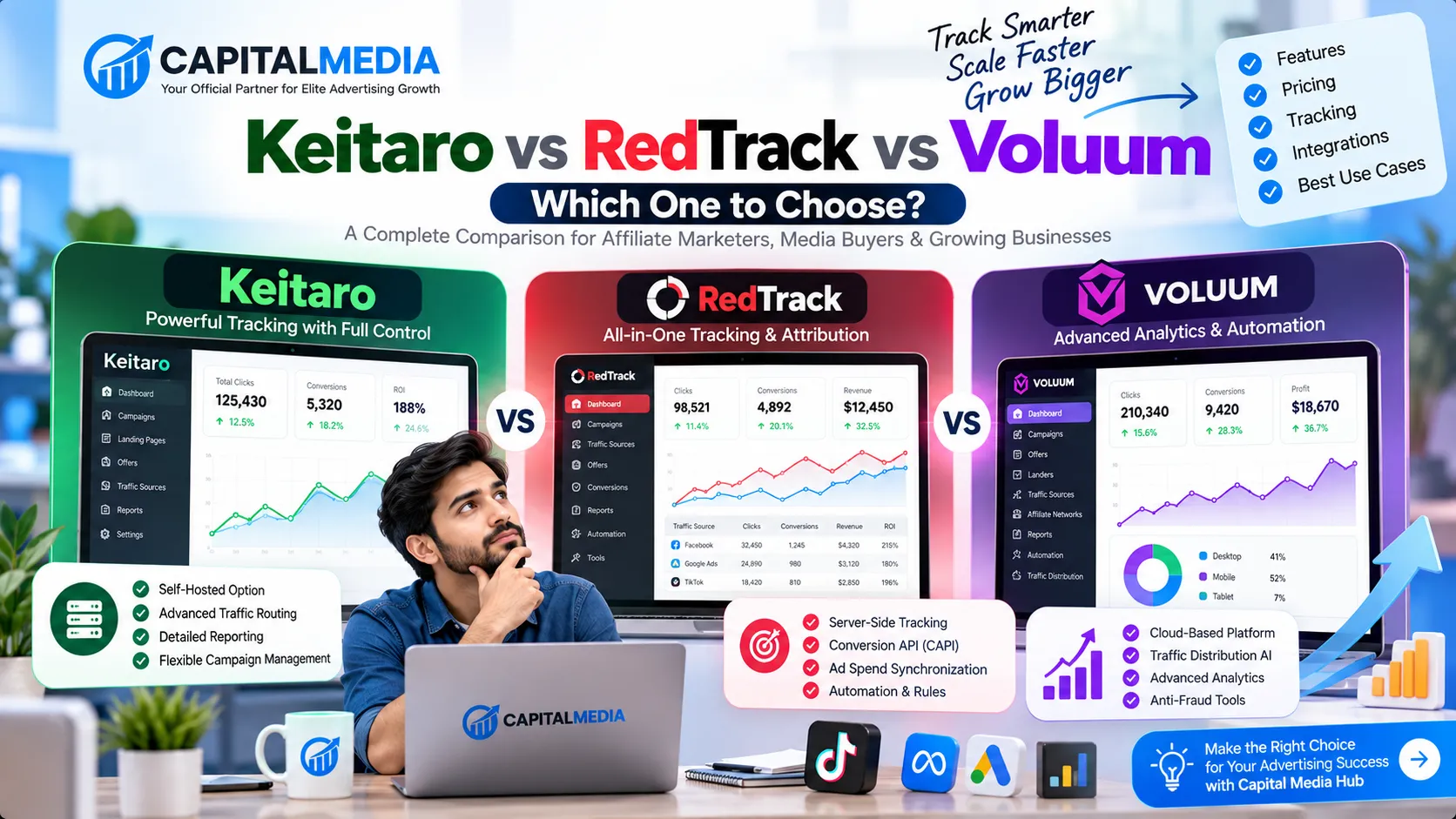
Choosing an ad tracker is not just about finding the platform with the longest feature list. The better question is: how do you buy traffic, what do you need to measure, how much technical control do you want, and how much automation does your team actually need?
Keitaro, RedTrack, and Voluum are all established advertising tracking platforms, but they are built around somewhat different workflows. Keitaro places a strong emphasis on flexible tracking, routing, reporting, and control. RedTrack combines tracking and attribution with server-side conversion sharing, automation, and media-buying tools. Voluum focuses heavily on cloud-based tracking, attribution, automation, AI-powered traffic distribution, and reporting. So, which one should you choose? There is no single answer that fits every advertiser. An affiliate media buyer running multiple offers may prioritize different capabilities from an e-commerce brand, while an agency managing several clients may care more about users, workspaces, reporting, and account management. This guide compares Keitaro vs RedTrack vs Voluum across tracking, attribution, automation, hosting, integrations, pricing, scalability, and practical use cases so you can make a decision based on your own advertising setup.
What Is an Ad Tracker and Why Do You Need One?
An ad tracker sits between your traffic sources, websites, landing pages, offers, and conversion data. Its job is to help you understand where visitors came from, what they did, and which campaigns or traffic combinations generated conversions. For example, imagine you are running campaigns on TikTok, Meta, and Google. Each advertising platform will show its own reporting. Your website or store may show another set of numbers. An affiliate network or CRM may report conversions differently again. An ad tracker can provide a central layer for collecting and analyzing these events. Keitaro describes its platform as a marketing attribution system that connects channels, campaigns, and touchpoints and provides reporting, routing, audience segmentation, conversion tracking, and cost management. RedTrack takes a similar approach but combines tracking and attribution with server-side tracking, Conversion API connections, ad-spend synchronization, automation, and campaign-management features. Voluum is also built around ad tracking and attribution, with redirect and direct tracking, API integrations, reporting, traffic distribution, automation, and anti-fraud capabilities. The important point is that an ad tracker does not automatically make an advertising campaign profitable. It gives you better information and, depending on the platform, tools to act on that information.
Keitaro vs RedTrack vs Voluum at a Glance
Before getting into the details, it helps to understand how the three platforms approach the problem.
Keitaro is particularly relevant if you want flexible campaign routing, detailed reporting, GEO and device-based filtering, and greater control over your tracking environment. Its current feature documentation includes flow management, landing-page editing, a built-in GEO database, Click API, Admin API, custom metrics, and integrations with advertising platforms including TikTok.
RedTrack is designed around tracking, attribution, conversion sharing, cost synchronization, reporting, and automation. Its current platform includes server-side tracking, CAPI, conversion-path reporting, attribution models, fraud detection, ad-level cost synchronization, stop rules, and integrations across advertising and affiliate platforms.
Voluum provides cloud-based tracking with redirect and direct tracking, campaign reporting, automation, traffic distribution, anti-fraud tools, API integrations, and AI-powered traffic distribution on applicable plans.
The differences become clearer when you look at how you actually intend to use the software.
Keitaro: What Does It Offer?
Keitaro is an advertising tracker designed for marketers who want to collect traffic and conversion information in one place while having detailed control over campaign flows. Its documentation lists features including traffic-source and affiliate-network statistics, 30-plus reporting metrics, GEO-based routing, device and browser filtering, flow rotation, split testing, conversion tracking, landing-page editing, and API access. One of Keitaro’s notable characteristics is its emphasis on traffic routing. You can build flows that distribute visitors according to factors such as geographic location, device, browser, mobile operator, or other conditions. This can be useful when the same advertising campaign needs to send different users to different landing pages or offers. For example, suppose you are promoting an offer in the United States and Canada. You may want visitors from the two markets to see different landing pages. A tracker with detailed routing rules can help you structure that journey from one tracking environment. Keitaro also offers integrations with Facebook, Google Ads, TikTok, Cloudflare, and other services depending on the license edition. Its current documentation specifically lists TikTok integrations as part of the available edition structure.
Keitaro Hosting and Technical Control
Hosting is one of the important differences to consider. Keitaro has historically been associated with self-hosted tracking, and its current product materials continue to emphasize flexible hosting and self-hosted options. Keitaro explains that self-hosted tracking gives businesses more control over their server environment, data, and storage capacity, while cloud tracking transfers infrastructure management to the provider. This can be attractive to technical media buyers who want more control over their infrastructure.
However, that control comes with responsibility. With a self-hosted setup, you may need to think about server configuration, security, backups, updates, domain configuration, and performance. If you do not have someone comfortable with server administration, this can become an additional task. Keitaro also offers current individual and business licensing options. Its published individual pricing currently starts at €40 per month for the Starter plan when billed yearly, with Advanced at €72 and Expert at €104. Business plans are separately listed for larger teams. Pricing can change, so it is worth checking the official pricing page before purchasing.
RedTrack: What Makes It Different?
RedTrack approaches ad tracking as part of a larger performance-marketing system. Its platform combines conversion tracking, attribution, reporting, ad-spend synchronization, conversion sharing, automation, and campaign management. One of its major technical features is server-side tracking. RedTrack currently supports direct, redirect, server-side, and parallel tracking methods, along with custom conversion types and conversion deduplication. This matters because modern advertising measurement is increasingly affected by browser restrictions, privacy controls, ad blockers, and incomplete platform signals. RedTrack also supports sending conversion information back to advertising platforms through APIs and server-to-server connections. Its documentation lists conversion sharing with platforms such as Meta, Google, TikTok, Snapchat, and others. For a performance marketer who wants the tracker to be part of the optimization loop rather than simply a reporting dashboard, these features can be important.
RedTrack for Affiliate Marketing and Lead Generation
RedTrack is also positioned toward affiliates and lead-generation teams. Its current affiliate tracking materials describe server-side tracking, ad-level cost synchronization, attribution models, bot and proxy filtering, unlimited campaigns and offers on its listed plans, and more than 200 integrations. This makes the platform relevant for media buyers who work with multiple traffic sources and affiliate networks. Imagine you are running several offers across different ad platforms. You may want to know not just how many clicks an ad generated, but which combination of traffic source, campaign, ad, placement, GEO, landing page, and offer produced conversions. RedTrack’s reporting and drill-down tools are designed around this type of analysis. It also provides automation rules that can pause campaigns or ads based on conditions you define.
RedTrack Pricing and Plans
RedTrack’s current pricing page lists separate structures for affiliates and lead generation as well as e-commerce and DTC teams. For the affiliate and lead-generation side, its current published plans include Builder at $69 per month on annual billing, Solo at $141, Team at $333, and Enterprise at $833. Monthly billing prices are higher. The plans differ by event volume, number of users, ad-account connections, domains, cost-sync frequency, and other capabilities. For example, the current Builder plan includes 2 million events per month and ad-spend synchronization every six hours, while Solo includes 5 million events and hourly ad-spend synchronization. Team and Enterprise increase event volume, users, and synchronization capabilities. RedTrack also publishes separate plans for DTC and e-commerce businesses, including Brand and Agency options. That distinction is useful because a Shopify store and an affiliate media-buying operation can have very different tracking requirements.
Voluum: What Does It Offer?
Voluum is another established advertising tracking platform with a strong focus on cloud-based infrastructure, attribution, campaign analytics, automation, and traffic optimization. Its current feature page lists redirect tracking, direct tracking, API integrations, real-time tracking, reporting, automation, and traffic distribution. Voluum also provides Traffic Distribution AI on applicable plans. This is designed to automatically distribute traffic toward better-performing landing pages, offers, or paths according to the system’s optimization logic. For media buyers managing multiple campaigns, automation can reduce repetitive manual work. For example, instead of checking campaign performance every few minutes and manually adjusting a routing rule, you can configure automation or traffic-distribution functionality according to your campaign strategy. Of course, automated optimization should still be monitored. Automation follows the data and rules available to it, so incorrect tracking or poorly configured conditions can produce unwanted results.
Voluum’s Reporting and Attribution
Voluum provides detailed reporting for campaign performance and supports multiple tracking methods. Its current documentation states that Voluum can track events such as page views, ad clicks, CTA clicks, and conversions, with additional information such as GEO, device ID, browser language, and browser version attached to tracked events. The platform also supports multiple traffic sources and affiliate networks, with integrations and templates designed for different advertising environments. For teams that need reporting across multiple campaigns and traffic sources, this can make the tracker useful as a centralized performance layer. Voluum also includes anti-fraud capabilities on relevant plans, including its Anti-Fraud Kit.
Voluum Pricing
Voluum currently uses a SaaS subscription model. Its pricing page lists the Profit plan at $119 per month when billed annually, Scale at $299, Startup at $539, Agency at $799, and higher Enterprise and Corporate options. The plans differ by active campaigns, landing pages, offers, traffic sources, affiliate networks, events, domains, data retention, users, automation, and reporting capabilities. Voluum also has Automizer pricing based on tracked ad spend, with additional costs depending on the spend limit. This is an important consideration when comparing the total cost of ownership rather than simply looking at the base subscription.
Keitaro vs RedTrack vs Voluum for Affiliate Marketers
If affiliate marketing is your primary use case, all three platforms can be relevant, but the workflow differences matter. Keitaro can make sense when you want detailed traffic routing, GEO filtering, custom flows, and a high degree of control over how visitors are distributed. Its documentation specifically highlights filters, flow rotation, landing pages, and affiliate-network tracking. RedTrack is relevant when you want affiliate tracking combined with server-side attribution, conversion sharing, cost synchronization, automation, and a large integration ecosystem. Voluum can suit media buyers who want cloud-based tracking combined with reporting, automation, traffic distribution, and anti-fraud functionality. The choice therefore depends heavily on whether your priority is infrastructure control, an integrated performance-marketing workflow, or cloud-based optimization and automation.
Which Tracker Is Suitable for E-Commerce?
E-commerce tracking introduces a slightly different set of requirements. A store may need to understand product views, carts, checkout activity, purchases, revenue, customer journeys, and advertising costs. RedTrack has a dedicated DTC and e-commerce offering with multi-touch attribution, sales and order synchronization for supported commerce platforms, ad-spend synchronization, and Conversion API capabilities. Keitaro can also track purchases, leads, subscriptions, and other conversion types and can synchronize costs from platforms including Meta, TikTok, and Google Ads. Voluum can track user-generated events and revenue-related campaign performance while connecting with advertising and affiliate platforms. For a store owner, the important question is not which tracker has the most features. It is whether the platform connects cleanly to your store, advertising channels, CRM, and reporting workflow.
Which One Is Better for Agencies?
Agencies have different requirements because several people may need access to different parts of the same system. Keitaro’s business plans currently support larger numbers of users and domains, with Team and Enterprise editions designed for larger operations. RedTrack provides team and agency-oriented plans. Its current Agency plan is designed for agencies running paid media across client accounts and includes unlimited users and stores/websites on that plan, along with attribution, CAPI, ad-spend synchronization, reporting, and account-management features. Voluum also offers Agency and Enterprise plans with additional users, workspaces, reporting, data retention, and account-management capabilities. An agency should therefore compare user permissions, client reporting, workspaces, domains, data retention, API access, and the cost of adding more clients.
Self-Hosted vs Cloud: A Major Decision
One of the simplest ways to narrow down your options is to decide how much infrastructure you want to manage yourself. A self-hosted tracker gives you more direct control over the server environment, but you are responsible for more of the technical maintenance. A cloud-based tracker removes much of that infrastructure work. Keitaro’s own comparison of cloud and self-hosted tracking explains this trade-off directly. Cloud services handle infrastructure management, while self-hosted systems provide more control over data, security, and storage but require the customer to manage the environment. RedTrack is cloud-based, so users do not need to provision and maintain their own tracking server. Voluum is also a cloud-based SaaS platform, with the provider managing the underlying infrastructure. If your team has strong technical resources and wants infrastructure control, this may push your evaluation in one direction. If you simply want to log in and start tracking campaigns, cloud hosting may be more convenient.
What About TikTok, Meta, and Google Ads?
If you are running traffic across major advertising platforms, integration quality matters. Keitaro’s current documentation lists integrations with Facebook, Google Ads, and TikTok, including the ability to bring advertising costs into the tracker and send conversion information back to advertising platforms. RedTrack supports integrations with Meta, TikTok, Google, Snapchat, and other advertising channels, with Conversion API capabilities included across its plans. Voluum supports major traffic sources and provides API-based integrations and postback capabilities for platforms including TikTok, Google Ads, Facebook, Bing, and Yahoo. Before selecting a tracker, check the exact integration you need rather than relying on a general statement that a platform “supports” an advertising network. The difference between basic tracking and two-way cost and conversion synchronization can be significant.
How Much Should Price Influence Your Decision?
Price matters, but the cheapest subscription is not necessarily the cheapest solution for your business. Suppose a tracker costs $50 less per month but requires you to spend several hours every week maintaining servers, fixing integrations, or manually exporting data. The actual operational cost may be higher. On the other hand, paying for advanced automation that your business never uses may also be unnecessary. Current published starting prices vary substantially. Keitaro’s individual Starter plan is listed from €40 per month on annual billing, RedTrack’s Builder from $69 per month on annual billing, and Voluum’s Profit plan at $119 per month on annual billing. These prices are not directly comparable because the platforms use different event limits, features, hosting models, and billing structures. Look at what is included at the level you actually need.
How to Choose the Right Tracker for Your Business
Instead of asking which platform is universally the best, start by answering five practical questions. First, where do you buy traffic? If you mainly run affiliate offers, your requirements may differ from those of a Shopify brand. Second, how much technical control do you need? If you want to manage your own infrastructure, a self-hosted option may be relevant. Third, do you need server-side conversion sharing? If your campaigns depend heavily on sending conversion signals back to advertising platforms, examine the available CAPI and S2S functionality. Fourth, how much automation do you actually need? A solo media buyer with ten campaigns may have little need for complex automation, while a large performance team may depend on automated rules. Finally, how many people, domains, campaigns, and events will you manage? This will affect which pricing tier makes sense.
Keitaro vs RedTrack vs Voluum: Practical Scenarios
If You Want More Control Over Routing and Infrastructure
Look closely at Keitaro. Its feature set includes detailed filters, traffic flows, GEO data, landing-page tools, APIs, and self-hosting options. This type of setup can appeal to media buyers who want to build customized tracking and routing logic.
If You Want Tracking Plus Server-Side Attribution and Automation
RedTrack is worth evaluating. Its platform combines server-side tracking, attribution, CAPI, cost synchronization, automation, reporting, and campaign-management features. This can be useful when you want the tracking platform to connect closely with the rest of your media-buying workflow.
If You Want a Cloud Tracker With Automation and AI Distribution
Voluum is worth considering. Its current platform includes cloud-based tracking, automation, Traffic Distribution AI, anti-fraud features, reporting, and integrations across advertising sources. This can suit teams that prefer a managed SaaS environment and want optimization tools built into the platform.
What Capital Media Hub Has to Do With Your Tracking Setup
An ad tracker and an advertising account solve different problems. The tracker helps you measure traffic, conversions, costs, revenue, and campaign performance. The advertising account is the infrastructure you use to actually run campaigns on a platform such as TikTok, Meta, Google, Snapchat, or another network. Capital Media Hub provides agency advertising account solutions across platforms including TikTok, Meta, Google, Snapchat, Taboola, Bing, and MediaGo. Its website also lists TikTok campaign management among its services. For businesses running paid acquisition campaigns, it can therefore be useful to think about these as two separate parts of the advertising stack: account infrastructure and measurement infrastructure. If you are looking for advertising account solutions, you can learn more through the official Capital Media Hub website:
The company states that clients are responsible for ensuring their advertising activity complies with applicable laws and platform policies, which is an important consideration whenever third-party advertising account services are involved.
Frequently Asked Questions
Is Keitaro better than RedTrack?
There is no single answer that applies to every advertiser. Keitaro emphasizes flexible tracking, routing, GEO filtering, reporting, and infrastructure control, while RedTrack places significant emphasis on server-side tracking, attribution, CAPI, cost synchronization, and automation. Your choice should depend on which capabilities fit your workflow.
Is RedTrack better than Voluum?
Both provide tracking, attribution, integrations, reporting, and automation, but their implementations and pricing structures differ. RedTrack currently emphasizes server-side tracking, CAPI, ad-spend synchronization, and integrated media-buying automation, while Voluum emphasizes cloud tracking, automation, AI-powered traffic distribution, and reporting.
Is Keitaro self-hosted?
Keitaro supports self-hosted deployments and promotes flexible hosting options. Its documentation also distinguishes cloud and self-hosted tracking approaches.
Is RedTrack cloud-based?
Yes. RedTrack describes its platform as cloud-based, so customers do not need to maintain their own tracking server.
Is Voluum cloud-based?
Yes. Voluum describes its tracker as a cloud-based SaaS solution where the provider manages the infrastructure.
Which tracker is suitable for affiliate marketing?
Keitaro, RedTrack, and Voluum can all be used for affiliate marketing. The better fit depends on your need for traffic routing, integrations, attribution, automation, infrastructure control, and reporting.
Which tracker is suitable for TikTok advertising?
All three have capabilities relevant to TikTok campaigns, but the integration details differ. Keitaro documents a TikTok integration, RedTrack provides TikTok cost and conversion integrations, and Voluum supports TikTok through its advertising integrations and postback/API capabilities.
How much does an ad tracker cost?
Current published starting prices vary. Keitaro’s Starter plan is listed from €40/month on annual billing, RedTrack Builder from $69/month on annual billing, and Voluum Profit at $119/month on annual billing. Features, event limits, and usage allowances differ substantially, so price alone should not determine the choice.
Final Thoughts
Keitaro vs RedTrack vs Voluum is less about finding a universal winner and more about matching the tracker to the way you buy and measure traffic. Keitaro gives advertisers extensive control over tracking flows, routing, GEO filtering, reporting, and infrastructure. RedTrack brings tracking, server-side attribution, conversion sharing, cost synchronization, reporting, and automation into one performance-marketing platform. Voluum provides a managed cloud environment with tracking, attribution, automation, traffic distribution, AI-powered optimization features, and anti-fraud tools. If you are a technical media buyer who wants control over tracking logic and infrastructure, study Keitaro’s hosting and flow capabilities carefully. If you want an integrated cloud platform with strong server-side attribution and media-buying automation, examine RedTrack’s tracking, CAPI, and automation features. If cloud infrastructure, reporting, traffic distribution, and built-in optimization are central to your workflow, Voluum’s feature set deserves a close look. The smartest way to make the final decision is to take one real campaign from your business and map it through each platform. Look at the traffic source, landing pages, conversion events, ad-spend data, attribution requirements, reporting, automation, integrations, and monthly event volume. Then compare the actual workflow and total cost rather than choosing based on a feature checklist alone. For businesses also looking for advertising account infrastructure across TikTok, Meta, Google, Snapchat, and other paid channels, Capital Media Hub provides agency advertising account solutions that can sit alongside your tracking and analytics stack.