
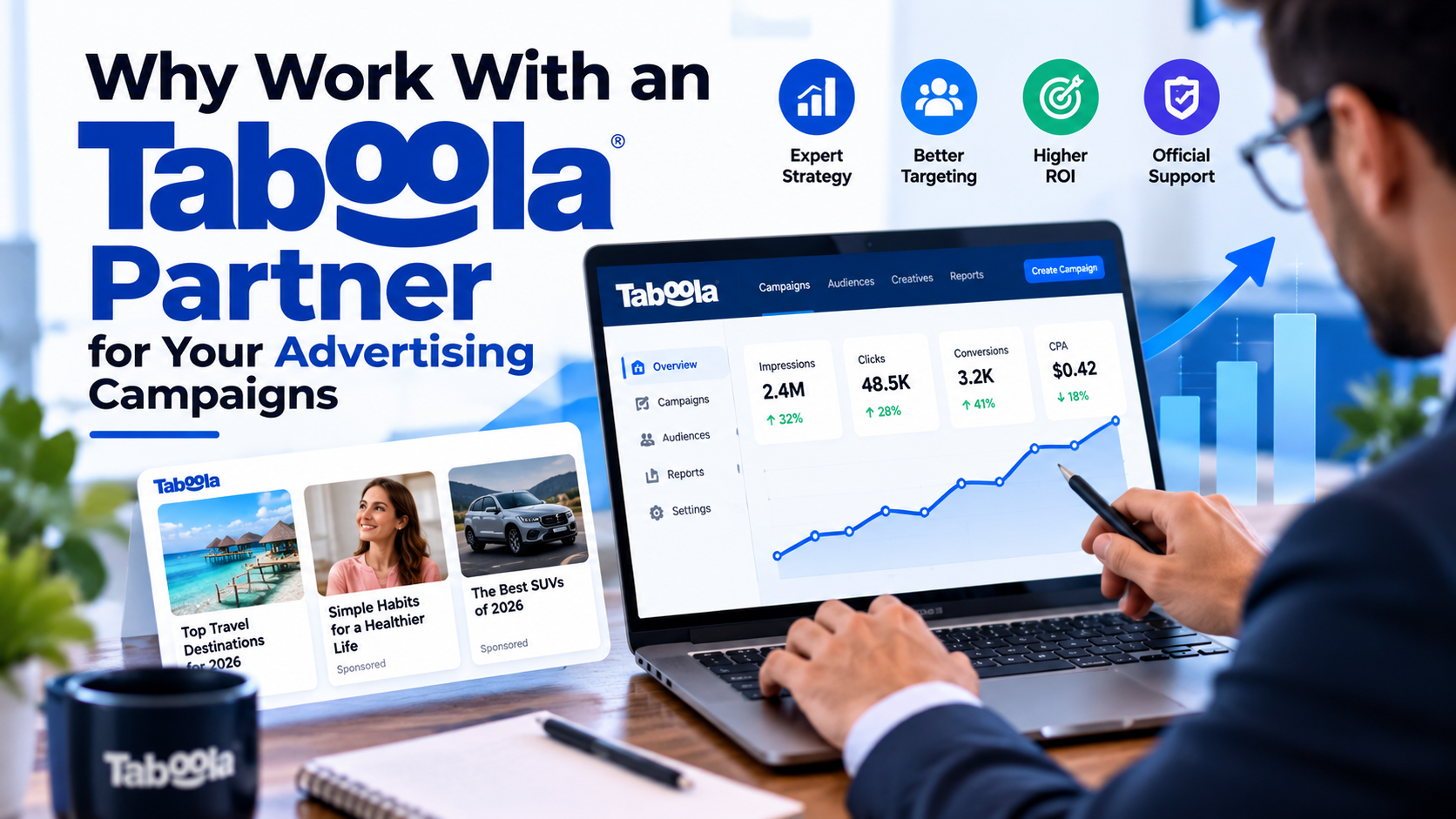
Why Work With an Official Taboola Partner for Your Advertising Campaigns?
Taboola can send a lot of traffic. It places sponsored content in recommendation widgets on large publisher sites, usually under articles, where readers are already in a browsing mood. For lead generation, ecommerce and content-led offers, that can be a very good fit.
Getting that traffic reliably is the hard part. New advertisers often run into slow approvals, campaigns that spend unevenly, creative that gets rejected without much explanation, and budgets that are harder to scale than they expected. Some respond by opening more self-serve accounts. Others buy access from sellers they find in chat groups, with no idea who actually set the account up.
There’s a better route, and it runs through Taboola’s own partner network. This article explains what an official Taboola partner is, why working through one changes your experience on the platform, where the risks sit with the alternatives, and how Capital Media Hub fits into that picture.
What “official Taboola partner” actually means
The phrase gets used loosely, so it helps to separate the different kinds of partner Taboola works with.
The first is the Taboola Marketing Partners directory. Taboola launched it in 2019 as a set of recommended companies that help advertisers do specific jobs better. When it went live, the listed partners covered content creation, translation and localisation, landing page builders, campaign tracking and video production. These are tool and service providers. They don’t sell ad accounts, and being listed there is a sign that Taboola sees them as useful for running campaigns on its network.
The second is the agency side. Taboola runs programmes for agencies and media buyers who manage spend on its platform. In 2020 it announced Taboola PRO, a global partner programme offering training, workshops, best practices and direct advice from Taboola’s own team. Agencies that work closely with Taboola at this level tend to have a named contact at the company, earlier word on platform changes, and a better understanding of how reviews are actually decided.
When an advertiser says they want to work with an official partner, they usually mean this second group: an agency with a direct, recognised relationship with Taboola, whose accounts sit inside that relationship. That’s the kind of setup this article is about.
Why working through a certified partner changes the experience
None of this means a partner can get anything approved. Taboola reviews every campaign and every ad against the same policies, whoever is running it. What changes is almost everything around that review.
You know where you stand with the account. An account created inside a recognised agency’s setup has a clear owner, a clear billing arrangement and a history Taboola can see. If questions come up about the account, there’s a legitimate business to answer them. That matters far more than it sounds the first time you need help.
Problems get explained, not just flagged. Taboola’s help centre lists the common rejection reasons: misleading headlines or images, misleading landing pages, missing disclosures, prohibited products, broken URLs and low-resolution thumbnails, among others. A rejection notice tells you which bucket you fell into. An experienced partner can usually tell you why, and what to change so the next version passes.
Scaling is less of a fight. Native campaigns often need a learning period before they settle, and budgets have to grow in steps. A partner with spend history across many campaigns has a feel for how fast you can push before delivery wobbles, which saves money that would otherwise go on trial and error.
Your knowledge stays current. Native advertising rules move. Agencies in close contact with Taboola tend to hear about changes before they show up as rejected campaigns. When you work through them, you get that advantage second-hand.
For most advertisers the real benefit is fewer surprises. You still have to run good campaigns. You just spend less time fighting the setup around them.
The trouble with going it alone, or going cheap
A self-serve Taboola account is a perfectly reasonable place to start. You sign up, add a payment method, upload creative and wait for review. For small tests that’s often enough.
The limits show up as you grow. A brand-new account has no history for Taboola to judge it by, so it’s normal to see more caution early on. Support is there, but you’re one advertiser among many. And if your account gets paused, everything you run is paused with it, because there’s nothing else to fall back on.
The riskier path is buying access from unknown sellers. These accounts are often advertised as “verified” or “whitelisted”, but you rarely learn who opened them, which business details are on file, or whose payment history they carry. The questions that matter most usually go unanswered:
- If the account is suspended, does your balance come back, and who decides?
- Who else can log in and see your campaigns, tracking and conversion data?
- If Taboola asks the account holder to verify the business, can anyone actually do it?
When those answers are vague, you’re taking on all the risk while the seller takes your money. Losing an account also costs more than the balance on it. You lose the learning your campaigns had built up, the time spent getting creative approved, and the momentum of something that was working.
The common thread is accountability. With a recognised partner, someone with a real relationship to Taboola is responsible for how the account was set up and how it’s run. With an unknown seller, nobody is.
Where Capital Media Hub fits
To be clear from the start: Capital Media Hub is not a direct Taboola partner itself. What it does is work with agencies that are. The accounts it provides come through those certified partner relationships, not from anonymous sellers or self-made setups.
For an advertiser, that gives you access to agency-level infrastructure without having to qualify for a partner relationship on your own. Most direct partners work with large agencies and brands and aren’t set up for individual media buyers or smaller teams. Capital Media Hub sits between the two: it handles the partner relationship and gives you an account you can launch from.
Here’s how its Taboola ad accounts work in practice:
- You share your campaign details, target markets and goals.
- The team matches you with a suitable account.
- You complete verification and set up billing.
- Campaigns can typically go live within 24 hours.
You can rent an account, which suits testing and short-term campaigns, or set up something longer-term. Pricing is a top-up fee of 5% to 10% on the ad spend you load. The rate depends on your spending history, payment volume and campaign category, and it’s shown before you confirm a payment. Payments can be made by bank transfer, PayPal, Payoneer or major cryptocurrencies.
The refund policy is also stated plainly. If an account is suspended or becomes ineligible, unspent balance is refunded to the original payment method within one business day. Misuse or fraud ends the arrangement without a refund. Capital Media Hub is also clear that advertisers remain responsible for keeping their campaigns compliant with the law and with Taboola’s policies.
The team mainly supports lead generation, ecommerce, affiliate and brand awareness campaigns, across markets including the US, Canada, the UK, Europe and Asia.
What still decides whether your campaigns work
A good account gets you to the starting line. Whether you stay there depends on the campaigns you put through it, and Taboola’s rules are worth knowing well.
Start with the match between ad and page. A common rejection reason is a headline or thumbnail that promises something the landing page doesn’t deliver. If your ad says “see the full price list”, the page should show the price list, not a lead form asking for an email first. Native readers click out of curiosity, so a mismatch also wrecks performance even when it gets past review.
Landing pages get almost as much attention as the ads. Taboola’s landing page policy asks advertisers to:
- make company and contact details easy to find
- label promotional content that could pass for editorial, for example with an “Advertorial” banner
- disclose paid endorsements and results that aren’t typical
- avoid fake urgency, such as countdown timers or offers that claim to end when they don’t
- show shipping costs next to any “free” claim
The advertorial rule trips up many advertisers. Pages built to look like a news story, with a fake byline and a “breaking” feel, are exactly what reviewers look for. You can still use long-form content that informs and persuades. It just has to be honest about what it is.
Thumbnails need more care than people expect. Low-resolution images are a rejection reason in their own right, and a clear, relevant photo usually beats an overdesigned graphic. Test several images and headlines per campaign, because on native placements those two elements do most of the work.
Finally, give campaigns time and room to learn before you judge them. Cutting budgets after a day or two of uneven spend tends to reset progress. A partner who has seen many campaigns through that early phase can tell you what’s a normal wobble and what’s a real problem.
Questions to ask before you choose a provider
Whoever you end up working with, a short conversation will tell you most of what you need to know:
- Is the account created through an agency with a direct Taboola relationship, and can you say which kind?
- Whose business details are on the account, and who else can access it?
- What happens to my balance if the account is suspended, and how quickly is it returned?
- What exactly is the fee, and is it charged on top-ups, on spend or both?
- Who do I contact when a campaign is stuck in review?
- Which verticals and markets do you support, and which do you turn away?
The last question is more telling than it looks. A provider who turns away some campaigns understands the rules. One who says yes to everything is setting you up for a suspension later.
Getting started with Capital Media Hub
If you want the stability of agency infrastructure on Taboola without waiting to qualify as a partner yourself, renting through Capital Media Hub is a practical way to start. You get an account that comes through certified Taboola partners, a published fee, a clear refund policy and a team you can contact.
Tell the team your niche, target countries and expected monthly spend through the Taboola ad accounts page or the contact page. They’ll recommend a setup and let you know what’s needed to get your first campaign live.